

Motorsport’s Next Brand Test Is Behind the Scenes
The commercial story of racing is expanding beyond the broadcast. For brands, the harder question is who can turn the promise of access into an experience worth returning to.
DUĒLL Journal ·
Dimitrije Djekanovic / Pexels — Pexels License
The most revealing document in motorsport marketing might not be a sponsorship announcement. It might be a job description. Among McLaren Racing’s listings on Motorsportjobs.com are roles focused on commercial process improvement and marketing planning and delivery. Not the glossy end of racing. The machinery underneath it. For brands considering a place in the sport, those descriptions offer a useful prompt: before buying into the spectacle, look at the organisation expected to deliver it.
Read the jobs, not just the forecast
McLaren’s advertised process-improvement role supports a Marketing & Commercial transformation programme, including the design, documentation and implementation of end-to-end processes. Its Head of Marketing & Commercial Planning & Delivery role is tasked with ensuring the function has the capacity, capabilities, resources and plans to execute strategic priorities and customer commitments.
Those are specific recruitment briefs, not proof of an industry-wide transformation. They do, however, make a usually invisible part of sports marketing visible. A commercial promise needs people, decisions and delivery systems behind it. Someone has to translate the partnership deck into a workable schedule.
The wider commercial context helps explain why that deserves attention. In its October 2026 report, Global Market Insights describes motorsport as moving away from a primarily broadcast-led model towards a more diversified mix of sponsorship, streaming, premium hospitality and direct fan monetisation.
The firm estimates the global market at $12.02 billion in 2025 and projects $25.54 billion by 2035. That is a forecast, not a guaranteed destination. Its definition includes series operation, media rights, sponsorship, live attendance, hospitality and officially licensed merchandise across professional and semi-professional racing.
For a prospective partner, the useful point is the range of commercial activity, rather than the size of the headline. A partnership brief should establish which part of that mix the brand wants to enter—and what it is equipped to contribute.

Scott Foltz / Pexels — Pexels License
Access is a promise, not a product description
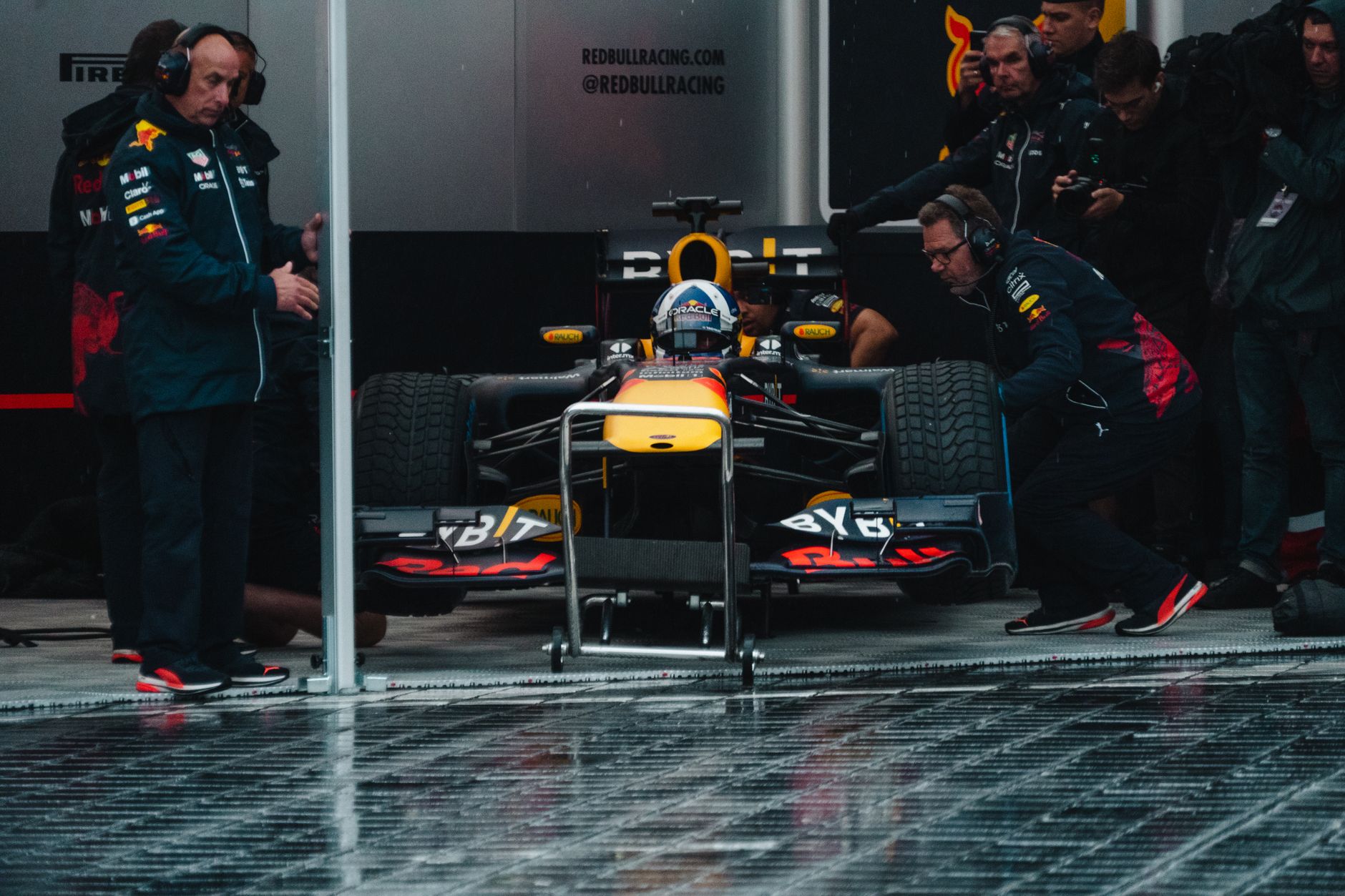
How should a company approach motorsport hospitality? Start by defining what the guest should understand, feel or be able to do afterwards. Then design the access around that purpose. A prestigious location is a setting. It is not, on its own, an experience strategy.
A proposed programme might prioritise conversations with business partners, an introduction to the technical side of racing, or a shared occasion for an existing customer community. These are different briefs. They require different hosts, different pacing and different measures of success.
That distinction matters when assessing a rights package. Which elements are confirmed? Which depend on availability? Who handles a change of plan? What can a guest reasonably expect? These questions are less photogenic than a circuit backdrop, but they belong in the creative conversation, not just the contract review.
The experience is only as strong as the promise you can actually keep.
The same discipline should apply to professionals involved in an event. If a driver appearance is part of a proposed programme, its purpose, preparation and boundaries should be clear. An athlete should not be expected to rescue an underdeveloped format simply by entering the room.
Good planning leaves space for human interaction. It does not script every exchange. The objective is to remove avoidable friction so the sporting experience can carry the occasion.
Build the handover into the idea
At DUĒLL we see the operational brief as part of brand building, not an administrative appendix. The creative concept should explain both what makes an experience distinctive and how the people delivering it can make that distinction tangible.
For a motorsport activation, that means testing the handovers before approving the headline idea. Who owns the relationship between rights holder and brand? Who briefs the hosts? Who communicates with guests? Who has authority to change the programme? Where does the event team’s responsibility end and the follow-up begin?
Global Market Insights identifies circuit access and team economics as constraints on the breadth of participation. That is a useful counterweight to the growth narrative. A commercial strategy cannot assume unlimited access simply because demand looks attractive.
Brands should therefore ask what remains valuable if the most exclusive element becomes unavailable. If the answer is nothing, the concept may be too dependent on a single permission. Interpretation, thoughtful hosting and a coherent programme should have a role of their own.
Measurement also belongs in the initial brief. For a relationship-led event, consider the quality of subsequent conversations and whether guests want to return. For an educational format, assess what participants understood. These are proposed evaluation choices, not universal benchmarks. The right measure follows the purpose.
What it means
For brands, assess delivery capability alongside rights and visibility. Ask for named responsibilities, realistic access conditions and a clear guest journey before committing to the creative promise.
For clubs, teams and rights holders, make commercial commitments legible internally. A package should be understandable to the professionals who must deliver it, not only to the people selling it.
For athletes, agree a meaningful role and workable boundaries. For communities, ask whether the programme offers something worth participating in beyond proximity to prestige—and whether there is a credible route to stay involved afterwards.
Motorsport’s expanding commercial mix creates more possible entry points. It does not make every entry point appropriate for every company. The stronger partnership starts with a precise purpose, respects the limits of the sport and funds the work behind the experience. Beyond the spectacle, that is the brand test.
More from the Journal

Sports · 1 November 2026
Padel: A Ranking Is Not a Roadmap
The FIP Promises Continental Finals give junior padel a new destination across four continents. The harder task is making the route there understandable—and worth supporting.

Sports · 27 October 2026
Padel: One Global Map. Different Local Games.
Europe holds 62.5% of padel courts, but Asia now leads on new club openings. From mature Spain to fast-building Indonesia, the next opportunity depends on knowing what each market actually needs.

Sports · 22 October 2026
A New League Needs a Reason
The debate around NBA Europe asks a harder question than who can build the bigger competition: what would a new league actually improve? For sports businesses, the answer should come before the launch.